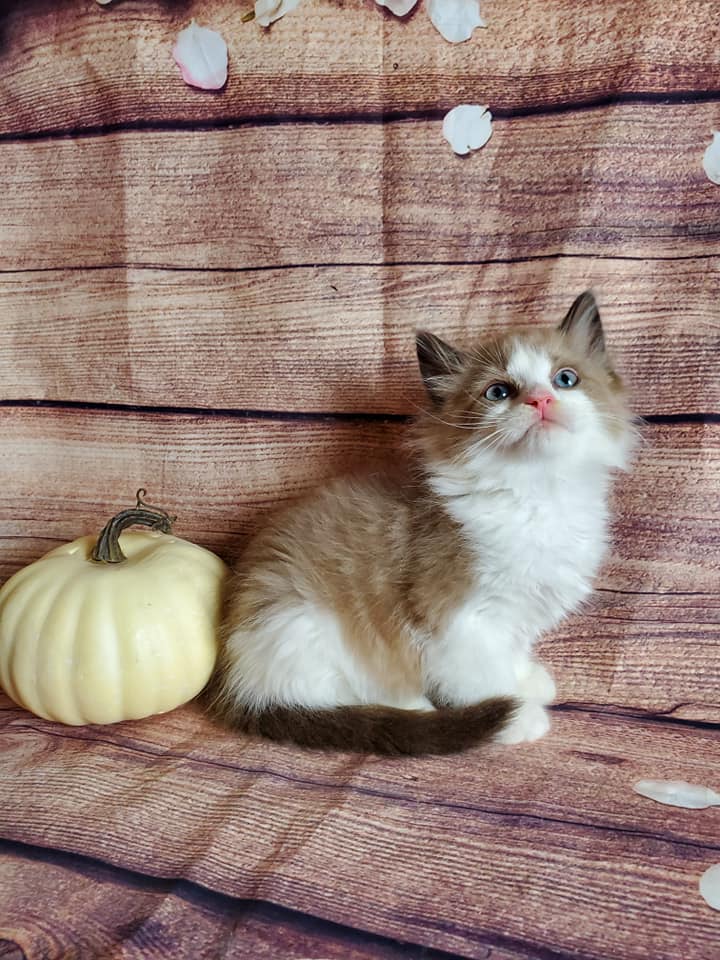
Ragdoll Coat Colors and Patterns Beyond Seal and Blue
Ragdolls are often pictured in seal or blue, yet their colour range is considerably broader. Chocolate, lilac, red, cream, tortie and lynx variations create a palette that can look very different as a kitten develops. The familiar blue-eyed expression remains central to the breed, but the distribution of colour and pattern determines much of each cat’s characterful appearance.
Ragdoll colour is also gradual. Kittens are born pale because the colourpoint gene is temperature-sensitive, so their ears, face, legs and tail darken as they mature. A warm Australian home may influence how quickly contrast develops, although genetics remains the main factor.
For Australian families, coat choice is only one part of responsible adoption. A kitten should come from a breeder who can explain parentage, health screening, socialisation and registration clearly. This matters whether the cat will live in a Melbourne apartment, a Brisbane townhouse or a spacious Perth home.
A beautiful pattern should never outweigh temperament and health. A cage-free, family environment with daily handling can help kittens become confident companions, and the family-raised kittens approach is especially relevant for households seeking a gentle pet or potential therapy cat.
The Ragdoll Colour Foundation
Seal is the deepest traditional colour, appearing as rich brown on the points. Blue is its diluted form, producing cool slate-grey markings. These colours are genetically common and are often the first examples people encounter when researching Ragdoll kittens.
Chocolate is a warm milk-chocolate shade, while lilac is its softer dilution, ranging from pale dove-grey to a pinkish mushroom tone. Both can be subtle in young kittens, so photographs should be viewed alongside information about the parents and expected adult development.
Red and cream occur in warm shades from apricot to pale ivory. Because the red gene is sex-linked, red and cream females are less common than males, while tortie patterns are generally found in females. Coat colour alone cannot reliably establish a kitten’s sex or quality.
Pointed, Mitted And Bicolor Markings
A colour describes the shade; a pattern describes where it appears. In a colourpoint Ragdoll, the face mask, ears, legs and tail carry the main colour while the body remains pale. The contrast usually strengthens with age.
Mitted Ragdolls have white paws and often a white chin or chest, with the front legs appearing gloved and the hind legs showing white up the hocks. Some have a narrow white blaze. Bicolor cats have more extensive white, including an inverted V on the face, white legs and a pale body.
Markings can vary in neatness, particularly in pet-quality kittens. A small asymmetry does not make a companion less loving or healthy. Families should distinguish between a show-standard pattern and a well-socialised pet whose markings are simply less exact.
Lynx, Tortie And Torbie Effects
Lynx refers to tabby striping layered over a pointed colour. It may appear as forehead lines, cheek stripes, banded legs or a ringed tail. Seal lynx can look dramatically different from solid seal because the face has a more defined, striped expression.
Tortie combines red or cream with another colour, creating mottled or patched areas across the points. When tortie and lynx occur together, the result is often called torbie. These patterns can be highly individual, with one kitten showing a strong facial splash and another displaying only delicate warmth on the ears or tail.
The same pattern terms can be combined with mitted or bicolor markings. For example, a blue lynx mitted Ragdoll has a diluted grey tabby effect, white gloves and the other features associated with the mitted pattern.
Colour And Pattern At A Glance
| Colour or effect | Typical appearance | Common pattern combinations |
|---|---|---|
| Seal | Deep brown points | Colourpoint, mitted, bicolor, lynx |
| Blue | Cool grey points | Colourpoint, mitted, bicolor, lynx |
| Chocolate | Warm brown points | Colourpoint, mitted, bicolor, tortie |
| Lilac | Pale grey-pink points | Colourpoint, mitted, bicolor, lynx |
| Red | Orange to apricot points | Colourpoint, mitted, bicolor, lynx |
| Cream | Soft ivory or pale apricot points | Colourpoint, mitted, bicolor, tortie |
| Tortie | Mixed red or cream with another colour | Mitted, bicolor, lynx |
| Lynx | Tabby striping over the base colour | Colourpoint, mitted, bicolor |
| Torbie | Tortie colouring with tabby striping | Mitted or bicolor |
This terminology is useful when comparing breeder descriptions, pedigrees and photographs. In Australia, buyers may see differences between TICA terminology and the language used by local registries or informal advertisements, so asking for the registered colour and pattern is sensible.
Why Kittens Change As They Grow
Ragdoll kittens often look almost white at birth, with faint shadows on the ears, nose or tail. Their extremities cool more quickly than the torso, activating colour in those areas. Over the first months, the points become clearer and the body coat may develop a gentle cream or beige cast.
Adult colour can continue to deepen for several years. Seal and chocolate usually become richer, while blue and lilac retain a cooler, mistier appearance. Red, cream and tortie patches may become easier to distinguish as the coat lengthens.
Photography can be misleading because indoor lighting, camera settings and grooming affect appearance. A breeder should provide recent images in natural light and explain whether a kitten’s colour is provisional. Descriptions such as “blue-based” or “warm-toned” should be supported by pedigree information rather than used as marketing alone.
Choosing A Coat For Australian Living
Ragdolls have a semi-long coat that benefits from a weekly comb, with extra attention during seasonal shedding. In warmer areas such as Brisbane, Darwin and northern New South Wales, regular grooming helps remove loose hair, but shaving is rarely necessary and can remove useful protection from sun and temperature changes.
Indoor living is especially practical in Australian cities, where roads, snakes, ticks and heat can create risks. A secure cat enclosure, screened balcony or supervised outdoor area offers enrichment without making roaming the default. Fresh water, shaded resting places and air conditioning are valuable during summer heatwaves.
Local regulations vary by state and council. Cats may need microchipping and registration, and desexing rules or containment requirements differ between jurisdictions. Anyone importing a breeding cat into Australia must also investigate federal biosecurity permits, quarantine and vaccination requirements well before travel; importing a pet is very different from buying a kitten from an Australian breeder.
Looking Beyond The Colour Label
A responsible breeder should discuss health testing alongside colour genetics. Ragdolls can be screened for hypertrophic cardiomyopathy, commonly abbreviated HCM, and families should also ask about testing for FIV, FeLV and feline heartworm disease where relevant. These checks do not guarantee a lifetime free of illness, but they demonstrate a serious breeding program.
Temperament is shaped by genetics, early handling and the home environment. Daily human contact, household sounds and gentle routines can help kittens adapt to families with children or other pets. For Australians seeking a therapy companion, a calm response to handling and new surroundings is more important than a rare colour.
When comparing the local market, avoid paying a premium simply because a listing uses words such as “exclusive” or “ultra rare.” Confirm vaccination records, desexing arrangements, microchip details, registration documentation and a written agreement. The most useful practical choice is to select the healthiest, best-socialised kitten whose colour and pattern suit your household, then maintain weekly grooming, indoor safety and regular veterinary care.