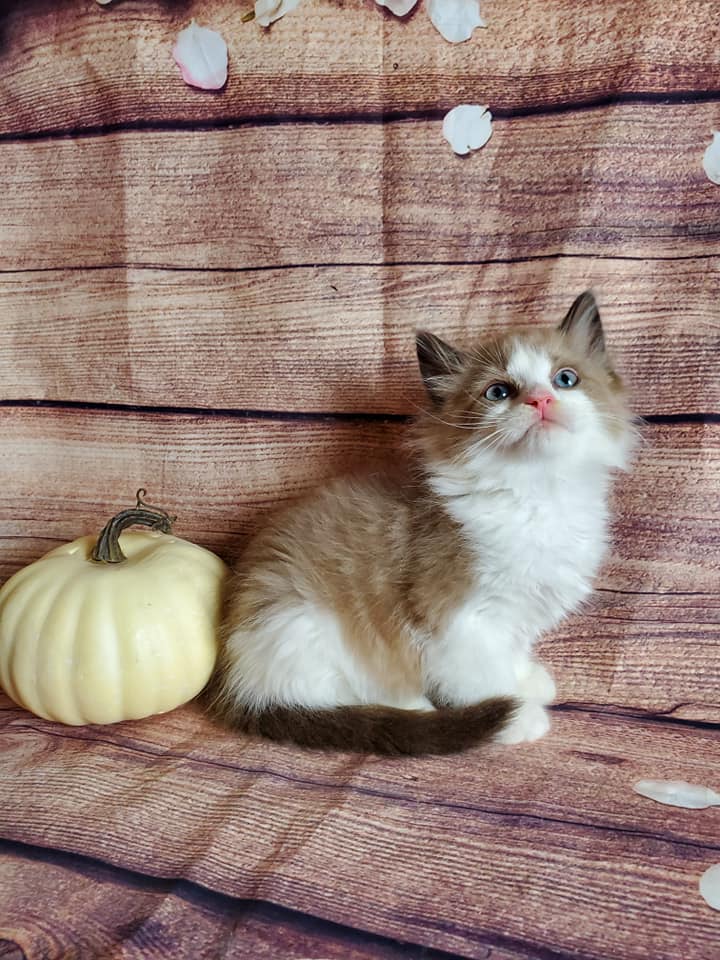
Mitted, Bicolor, And Colorpoint Ragdolls Explained
Ragdoll kittens are famous for their gentle personalities, blue eyes and colour-pointed coats, yet their markings can look quite different from one another. Mitted, bicolor and colourpoint describe the distribution of white and darker pigment, rather than separate Ragdoll breeds.
For Australian families comparing kittens from a registered breeder, understanding these patterns makes it easier to interpret photographs, pedigrees and adoption descriptions. A seal mitted kitten and a seal bicolor kitten may share the same colour genetics while looking strikingly different.
The pattern you choose should complement your household, but appearance is only part of the decision. Temperament, early handling, health screening and the breeder’s approach to raising kittens indoors all matter when bringing a Ragdoll home to Sydney, Melbourne, Brisbane or beyond.
| Ragdoll Pattern | Main Appearance | White Markings | Common Visual Feature |
|---|---|---|---|
| Colourpoint | Darker ears, face, legs and tail | No significant white | Clear contrast between points and body |
| Mitted | Coloured points with white paws | White “mittens”, often a chin or belly stripe | White front paws and higher white back feet |
| Bicolor | Coloured ears and mask with substantial white | White legs, underside and face blaze | Inverted V on the face |
What Colourpoint Ragdolls Look Like
Colourpoint Ragdolls have the classic pointed pattern associated with the breed. Their ears, mask, legs and tail carry deeper colour, while the torso remains lighter. The face generally has no deliberate white marking, and the contrast becomes stronger as the kitten matures.
Seal and blue are widely recognised colourpoint shades, while chocolate, lilac, flame and cream may also appear in Ragdoll lines. Lynx striping and tortie colouring can modify the points without changing the basic colourpoint pattern.
Ragdoll kittens are born very pale because their colour develops gradually with exposure to cooler body temperatures. This means an Australian buyer may receive early photographs that do not show the final contrast clearly, particularly if the kitten is still very young.
How Mitted Markings Differ
Mitted Ragdolls have darker ears, faces, legs and tails, with white on the paws. The front paws resemble small gloves, while the back legs often have white that extends higher. Many mitted cats also have a white chin, chest or belly stripe, although the exact shape and balance vary.
A well-defined white blaze may appear on the face, but it is not required for every mitted kitten. Breeders may describe markings as “high mitted” or mention an uneven blaze when explaining how much white a kitten has.
Pattern terminology describes looks rather than personality. A mitted Ragdoll is not automatically quieter, cuddlier or more suitable as a therapy cat than a bicolor or colourpoint. Daily handling, family interaction and the individual kitten’s temperament are more useful indicators.
Recognising Bicolor Ragdolls
Bicolor Ragdolls usually have more white than mitted cats. The face often features a distinctive inverted V, with colour around the ears and upper mask and white across the nose and lower face. The legs, chest and underside are also predominantly white.
The inverted V can be narrow, broad, symmetrical or slightly uneven. Show-oriented descriptions may place importance on balanced markings, while a pet home can reasonably focus on health and character rather than perfect facial geometry.
Bicolor kittens can be especially difficult to assess from a single image because lighting changes the apparent boundary between white and pale body colour. Ask for natural-light photographs and, when possible, videos showing the kitten moving, playing and interacting with people.
Colour And Pattern Are Separate Traits
Seal, blue, chocolate, lilac, flame, cream, lynx and tortie refer to colour or overlay, while mitted, bicolor and colourpoint refer mainly to pattern. A kitten can therefore be a blue mitted, seal bicolor or flame colourpoint Ragdoll. These combinations explain why two kittens from the same litter may look unrelated at first glance.
All accepted Ragdoll patterns develop from the breed’s colour-point genetics, and blue eyes are a characteristic feature. Coat shade may deepen with age, especially around the ears, face, legs and tail. Seasonal temperature changes can also influence how dark the points appear.
Markings should never distract from responsible health checks. Before reserving a kitten, review the breeder’s approach to screening for conditions such as hypertrophic cardiomyopathy, FIV, FeLV and feline heartworm disease. This guide to spotting a healthy kitten provides useful background for assessing visible signs, although a veterinary examination remains important.
Choosing A Ragdoll For An Australian Home
Australian households may have practical considerations that buyers elsewhere do not. Long-distance transport between a Montana-based cattery and cities such as Perth, Adelaide or Canberra requires careful planning, while local families may need to check rental rules, pet deposits and indoor-cat requirements before adoption. In warmer areas, reliable air conditioning and cool sleeping spaces are particularly important for a long-haired breed.
Ragdolls are generally suited to indoor living, where they can receive companionship and protection from traffic, snakes and extreme weather. Their silky semi-long coat still needs regular combing, and a gentle routine helps prevent mats around the armpits, ruff and hind legs. A kitten’s future family should also plan for a secure carrier, scratching posts, climbing areas and an Australian veterinary clinic.
Photographs are helpful for comparing coat patterns, but personality is best seen through everyday behaviour. Short videos of play, handling and family interaction can reveal confidence more clearly than a posed portrait; general photography tips can even help when documenting a kitten’s changing character, although that resource was created for dogs.
For a pet or therapy companion, select the kitten whose temperament fits the household rather than choosing solely by the amount of white on its face or paws. A calm, people-focused kitten raised cage-free in a family environment may be a better match than one with a preferred pattern but limited social experience.
The key distinction is simple: colourpoint Ragdolls have no significant white, mitted Ragdolls have white paws and limited additional markings, and bicolor Ragdolls have broader white areas, often including an inverted facial V. The pattern affects appearance; responsible breeding, health screening and early socialisation shape the companion you bring home.