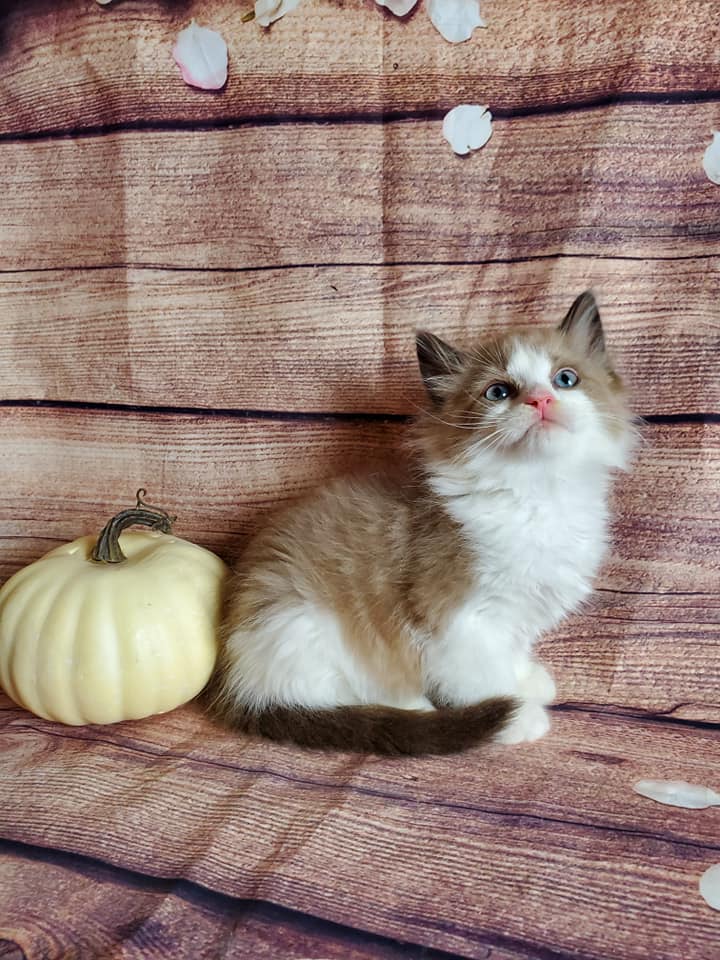
Ragdoll Point Colour Genetics And Changing Coat Patterns
Ragdoll kittens are often born with a pale, almost creamy coat, then gradually develop darker colour on the ears, face, legs and tail. This change is controlled by a temperature-sensitive gene, which makes the breed’s colouring especially interesting to watch during the first year of life.
For Australian families, the process can look slightly different from one home to another. A kitten growing up in air-conditioned Brisbane may retain a lighter body than one living through a cool Canberra winter, while natural coat changes can be more noticeable after a move between climates.
Understanding the genetics behind Ragdoll point colours helps owners recognise what is normal. It also makes it easier to interpret a pedigree, compare colour descriptions and choose a kitten from a responsible breeder such as a small, TICA-registered cattery in Helena, Montana.
How The Point Gene Works
Ragdoll colourpointing is linked to a recessive allele commonly written as cs. A kitten usually needs two copies, one from each parent, for the classic pointed pattern and blue eyes. The gene affects tyrosinase, an enzyme involved in producing melanin, the pigment responsible for hair colour.
The altered enzyme works more effectively in cooler parts of the body. The warmer torso therefore remains pale, while the cooler extremities develop pigment. This is why the ears, mask, paws and tail become the richest areas of colour as a Ragdoll matures.
A pointed Ragdoll inherits one colour gene combination, while its final appearance also depends on other genes. These additional genes influence whether the points are seal, blue, chocolate, lilac, red, cream, lynx or tortie.
Why Kittens Change Colour
Newborn pointed Ragdolls spend their time in a warm uterus, so their coats show little pigment at birth. Within the first days and weeks, the cooler areas begin to darken. The ears and nose are often among the first places where the developing pattern becomes clear.
The coat usually continues changing through kittenhood and may deepen until the cat is around two to four years old. Seal points commonly become rich brown to near-black, while blue points develop a softer slate-grey shade. Colour can remain subtle in young kittens, so an early photograph may not predict the finished contrast perfectly.
Seasonal shifts can also be visible. During a cold winter in Hobart or the Australian Alps, a Ragdoll may develop darker body shading. In a hot Darwin summer, the torso can appear lighter, although the genetic colour of the cat has not changed.
What Seal, Blue And Other Shades Mean
Seal is the most familiar Ragdoll point colour. It comes from the dense dark-brown form of the colourpoint gene combination. Blue is a dilution of seal, producing cool grey points rather than brown-black ones. A blue Ragdoll can look especially soft under indoor lighting.
Chocolate and lilac are also affected by dilution. Chocolate points are warm milk-chocolate brown, while lilac points are pale grey with pinkish or mushroom undertones. Red and cream points are produced through orange-colour genetics and can be more variable in intensity.
A breeder may describe a kitten as seal mitted, blue bicolour or lilac lynx. The first colour word identifies the pigment, while the later terms describe white distribution or tabby markings. The exact terminology should be checked against the registry standard used by the breeder, since Australian cat associations and overseas registries can present paperwork differently.
| Genetic or visual feature | Typical effect on a Ragdoll |
|---|---|
| Two colourpoint alleles | Pointed coat, usually with blue eyes |
| Seal pigment | Dark brown to brown-black points |
| Dilution gene | Seal becomes blue; chocolate can become lilac |
| Orange-linked colour | Red or cream points, often with male/female inheritance differences |
| Tabby modifier | Lynx stripes or bars within the coloured points |
| White spotting pattern | Colourpoint, mitted, bicolour or van pattern distribution |
| Cooler body temperature | Darker coat on ears, face, legs and tail |
How White Markings And Stripes Are Inherited
Point colour and white pattern are separate parts of the genetic picture. A colourpoint Ragdoll has coloured points without the typical white mitts or facial blaze. A mitted kitten has white paws and often a white chin or chest, while a bicolour has a broader inverted-V facial marking and more white across the body.
White markings can vary in extent, even among kittens from the same litter. They are not simply a lighter version of seal or blue. A seal bicolour and a seal mitted Ragdoll share the same base pigment but inherit different white-spotting patterns.
Lynx markings add tabby stripes to the points, particularly around the forehead, cheeks and legs. Tortie points combine red or cream areas with another base colour, creating mottled or patchy shading. Because the orange gene is carried on the X chromosome, tortie Ragdolls are overwhelmingly female, although rare genetic exceptions can occur.
Why Temperature Affects Coat Intensity
The colourpoint enzyme responds to skin temperature, not to sunlight or mood. Areas that are cooler produce more pigment, which explains the darker tail and paws. A shaved patch can also grow back darker because newly regrown fur may develop in a cooler area before the coat returns to its usual length.
Indoor heating and cooling can influence the overall impression of a coat, but they do not turn a blue cat into a seal or change a mitted cat into a bicolour. Genetics establishes the foundation; temperature affects how strongly that foundation is displayed.
Australian owners may notice this in practical ways. A Ragdoll in a well-cooled Perth or Brisbane home may keep a pale body, while a cat in Melbourne during a cool spell can show stronger shading. Coat changes are gradual and harmless when the cat is otherwise healthy, eating normally and maintaining a comfortable body temperature.
What Australian Families Should Check
Colour is only one part of selecting a Ragdoll. A reputable breeder should explain the parents’ colour genetics, expected markings and registry details rather than promising an exact adult appearance from a very young kitten. For an Australian buyer considering an overseas kitten, importing from the United States involves Department of Agriculture, Fisheries and Forestry requirements, approved veterinary paperwork, vaccinations and quarantine-related planning.
Health information matters just as much as colour prediction. Families should ask about screening for hypertrophic cardiomyopathy, commonly called HCM, as well as FIV, FeLV and feline heartworm disease where relevant. Kittens raised indoors in a cage-free family setting and handled daily are also more likely to arrive prepared for ordinary household life, travel and gentle veterinary care.
A Ragdoll’s mature colour is best judged alongside its pedigree, parents, health records and socialisation history. Before reserving a kitten, request the parents’ colour and pattern details, the kitten’s registration documents, and a written veterinary record showing the completed health checks.