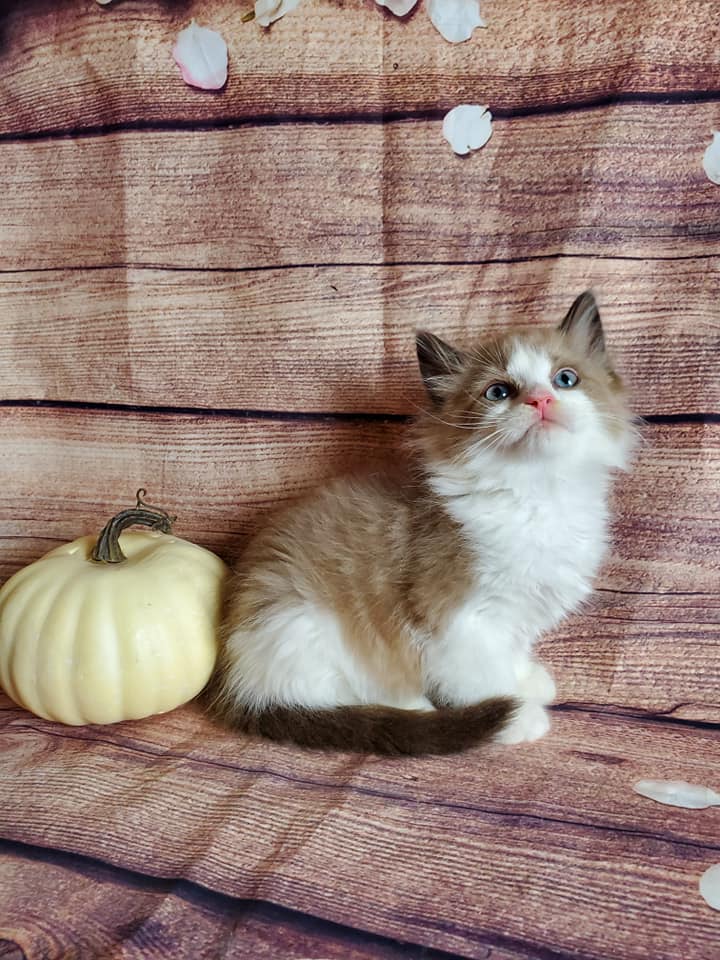
Understanding Ragdoll Coat Color Genetics and Pattern Inheritance
Few sights delight a visitor to a Ragdoll cattery quite like a litter of kittens revealing their eventual coats over the first weeks of life. The seal points darken around the face, ears, paws, and tail while the body stays creamy, and bicolor kittens develop distinctive inverted-V masks across their faces. Behind every blue mitted and every lilac bicolor is a tidy story of dominant and recessive genes interacting with a quirk of feline biochemistry.
Ragdolls carry the same Himalayan colourpoint mutation found in Siamese, Birman, and Himalayan cats. This single recessive allele alters an enzyme called tyrosinase so it functions only at lower temperatures. Because a kitten's extremities are cooler than its core, pigment develops in the points but not in the warm body. Australian summers in cities like Brisbane and Perth raise an interesting wrinkle: indoor climate control keeps most pet Ragdolls at a steady 22-24°C, which often results in slightly darker body shading than older show standards once described.
Responsible breeders plan matings around predictable outcomes rather than surprises. The four traditional base colours, the dilution gene, the white-spotting gene, and the colourpoint allele together determine what arrives in the nest. The following sections walk through how each contributes to the kittens raised at a TICA-registered hobby cattery in Helena, Montana, whose waiting list reaches families across Sydney, Melbourne, and Adelaide.
Understanding these mechanics also helps buyers ask better questions of any breeder they contact, including those advertising locally through ANCATS or Cat Council of Australia affiliated clubs. The same knowledge reassures owners that a winter-darker seal point in a chilly Adelaide Hills home is normal biology rather than a flaw.
The Colorpoint Gene and the Science Behind the Shading
The colourpoint pattern in Ragdolls traces to a mutation in the TYR gene that codes for tyrosinase, the enzyme responsible for melanin production. The variant, often written as c^s in feline genetics literature, is recessive to the full-colour allele (C). A Ragdoll must inherit two copies of the colourpoint allele for its signature pattern to appear. Any kitten receiving even one dominant C allele from a parent will grow up with solid, non-pointed fur.
Temperature sensitivity means that cooler body regions deposit more pigment than warmer ones. A kitten born uniformly cream or white gradually reveals its points as cells in the ears, nose, paws, and tail activate melanin. Climate matters: cats kept in air-conditioned Australian homes during hot Darwin summers often retain paler body coats than cats raised in unheated Tasmanian winters, where contrast grows stronger over cooler months.
The Four Base Colours and Their Genetic Codes
Three loci determine a Ragdoll's base colour. The B locus controls whether pigment is black-based (B) or chocolate-based (b). The D locus dilutes black to blue and chocolate to lilac when two recessive d alleles are present. The A locus influences agouti banding, though most Ragdolls are non-agouti and show solid points.
| Base Colour | Genotype (B/D Loci) | Visual Appearance |
|---|---|---|
| Seal | B- D- | Dark brown points, warm cream body |
| Blue | B- dd | Slate grey points, icy body |
| Chocolate | bb D- | Warm milk-chocolate points, ivory body |
| Lilac | bb dd | Pinkish-grey points, glacial white body |
Seal and blue remain the most common in Australian breeding programmes, partly because early imports from the United States carried these alleles. Chocolate and lilac are rarer and require both parents to carry the recessive b allele, which lengthens waiting lists for Sydney families hoping for these softer shades.
Dilute Inheritance in Litters
The dilute gene operates as a simple recessive. A cat must inherit d from both parents to display the diluted phenotype; otherwise it carries dilute silently. Many Australian breeders use genetic testing through services such as Orivet or UC Davis to identify carriers, which prevents unexpected lilacs in seal-point-to-seal-point pairings.
When a breeder mates a seal carrier of dilute (BBDd) with another carrier, roughly twenty-five percent of kittens are blue point, fifty percent are seal carriers, and twenty-five percent are non-carrier seal points. Planning matings around these ratios keeps breeding programmes predictable and avoids accidental colour surprises in pet-only kittens going to homes in Perth or Canberra.
Pattern Genes: Mitted, Bicolor, and High Mitted
Beyond colour, three recognised patterns appear in the Ragdoll breed standard. They are governed primarily by the white-spotting gene (S), which adds variable amounts of white, and the KIT gene, which influences the distribution of that white. Patterns require careful attention because the mitted and bicolor phenotypes depend on heterozygous combinations of spotting alleles, and two bicolor parents can produce mitted or colourpoint kittens.
- Colourpoint: solid point colour with no white markings
- Mitted: white chin, chest, front paws, and rear boots
- Bicolor: inverted-V facial mask, white legs, chest, and belly
Breeding two colourpoints together always yields colourpoints, while mating a colourpoint with a bicolor can produce a full litter of pointed kittens depending on the parents' white-spotting genotypes. Australian breeders importing new lines from overseas must verify pattern genetics to keep litters aligned with buyer expectations.
Predicting Outcomes from Pedigree Analysis
Pedigree software such as PawPeds allows breeders to calculate probabilities for each kitten in a planned litter. By entering the genotypes of both parents, the program displays the expected distribution of colours and patterns, including hidden recessives. For families in Adelaide waiting for a specific combination, such as a seal mitted with deep blue eyes, pedigree analysis gives an honest estimate of how many kittens in a typical litter might match.
Responsible breeders do not promise specific outcomes to buyers, because recessive combinations can stay hidden for generations. What they do offer is transparency: showing DNA test results, sharing five-generation pedigrees, and explaining which alleles each parent carries. This openness builds trust whether the kitten is destined for a Melbourne apartment, a Gold Coast family home, or a quiet rural property outside Hobart.
Health Testing and Ethical Considerations
Coat genetics matter, but they cannot overshadow health. The same cattery that studies colour inheritance should screen breeding cats for hypertrophic cardiomyopathy (HCM), feline immunodeficiency virus, feline leukaemia virus, and heartworm. Australian buyers should also confirm that kittens come microchipped, since state legislation across New South Wales, Victoria, Queensland, South Australia, Western Australia, Tasmania, and the ACT requires cats to be microchipped by six months of age. The ACT additionally enforces a cat containment rule, so indoor life is already standard for many feline residents of Canberra.
- DNA panels for HCM (MYBPC3 and MYH7 mutations)
- Annual echocardiograms for breeding adults
- Antigen testing for FeLV, FIV, and feline heartworm
- Early-age desexing before rehoming, per RSPCA Australia guidance
Buyers should ask for copies of veterinary records, parent DNA profiles, and references from previous adopters. A cattery that balances colour knowledge with strong health protocols produces kittens ready to thrive in Australian homes.
A sensible first step is to request the cattery's most recent HCM echocardiogram dates and DNA test panel, then schedule a video call to meet the queen, stud, and current litter before placing a waitlist deposit.